
A Western NC Homeowner's Guide to Spotting a Low-Refrigerant Heat Pump Before It Costs You
If your heat pump is running constantly but your house never quite gets comfortable, the first thing most homeowners in Asheville and Brevard wonder is whether it just "needs more freon." Sometimes that's part of the story — but here's the truth most HVAC companies won't lead with: a heat pump is a closed system. It doesn't burn refrigerant the way a car burns gas. If your refrigerant is low, it's because there's a leak somewhere, and adding more without fixing the leak is throwing money down the drain.
This guide walks you through the seven clearest warning signs that your heat pump is low on refrigerant, what's actually happening inside the unit when this occurs, and what a proper diagnosis and repair looks like.
First, A Quick Word on How Heat Pump Refrigerant Works
Refrigerant is the chemical that moves heat in and out of your home. In summer, your heat pump pulls heat out of your indoor air and dumps it outside. In winter, it does the reverse — it pulls heat from the outdoor air (yes, even cold air contains heat energy) and brings it inside. None of that is possible without a properly charged refrigerant loop.
When the charge drops — even by 10% — your system has to work dramatically harder to move the same amount of heat. Efficiency tanks, energy bills climb, and components like the compressor start running hot enough to fail prematurely.
The 7 Signs Your Heat Pump Is Low on Refrigerant
1. The Air Coming From Your Vents Isn't Cold Enough (or Warm Enough)
This is the most obvious symptom and usually the one that brings homeowners to the phone. In cooling mode, the air at your supply vents should be roughly 15–20°F cooler than the air at your return vent. In heating mode, you should feel air coming out noticeably warmer than room temperature — typically in the 90–105°F range from a properly working heat pump.
If your system is running but the air feels lukewarm in both modes, low refrigerant is one of the top suspects.
2. Your Heat Pump Runs Constantly and Never Shuts Off
A heat pump with the correct refrigerant charge should cycle on, reach the thermostat setpoint, and shut off. If yours is running all day or all night without ever satisfying the thermostat, it's likely because the system can't move enough heat per cycle to actually catch up.
This is also why heat pump repair calls spike during the first real heat wave of summer and the first cold snap of winter — borderline-low systems coast through mild weather and only show their problems under load.
3. Ice or Frost Buildup on the Indoor Coil or Outdoor Refrigerant Lines
This one surprises people. You'd expect low refrigerant to make things warmer, not colder — but the opposite happens. When pressure drops in the system, the evaporator coil gets too cold and condensation on it freezes into a sheet of ice. You may see frost on the copper refrigerant lines running to your outdoor unit, or ice forming on the indoor coil itself.
Important: A frozen heat pump in summer is almost always either a refrigerant issue or an airflow issue (clogged filter, blocked return, failing blower). Don't try to chip the ice off. Shut the system down, switch the thermostat to "fan only" to help it thaw, and call us.
4. Hissing or Bubbling Sounds Near the Indoor or Outdoor Unit
Refrigerant under pressure makes a hissing sound when it escapes through a small leak. A larger leak can sound like bubbling or gurgling. These sounds usually come from the line set (the copper pipes running between your indoor and outdoor units), at the service valves, or at the coil itself.
If you hear it, that's a leak in progress — and the longer the system runs, the more refrigerant escapes and the more strain your compressor takes on.
5. Higher Than Normal Electric Bills
Heat pumps are one of the most efficient heating and cooling options for our climate — that's exactly why they make sense in North Carolina. But that efficiency depends on a properly charged system. A heat pump low on refrigerant can use 20–30% more electricity to do the same job. If you've ruled out unusual weather or a change in your usage patterns and your bills are still climbing month over month, the system itself is the most likely culprit.
6. Water Pooling Around the Indoor Unit
When ice builds up on the indoor coil (see #3) and then eventually melts, it can overwhelm the condensate drain and spill out onto the floor or into the drain pan. If you're finding water around your air handler with no obvious plumbing source, frozen-coil-from-low-refrigerant is a common explanation.
7. The System Short-Cycles or Trips Its Breaker
When refrigerant is low, the compressor works harder, runs hotter, and draws more amperage than it's designed for. This can cause the system to trip on a high-pressure or thermal safety, shut itself off, restart, and trip again. Repeated short-cycling like this will eventually kill the compressor — and a compressor replacement is one of the most expensive repairs on a heat pump.
"Can I Just Add Refrigerant Myself?"
No — and not just because of the legal answer (the EPA requires Section 608 certification to handle refrigerants), but because of the practical one. If your system is low, it's because it's leaking. Topping it off without finding and fixing the leak does three things:
- Wastes money. You'll be doing it again in a few months.
- Damages the environment. Modern refrigerants are potent greenhouse gases.
- Hides the real problem. A small leak you could have caught at the line set can grow into a coil replacement or a full system loss if it's ignored long enough.
A proper repair starts with a leak search — using electronic detectors, UV dye, or a nitrogen pressure test depending on the situation — then repairing or replacing the leaking component, evacuating the system to a deep vacuum to remove moisture and air, and finally recharging to the manufacturer's exact specification by weight.
What About R-22 vs. R-410A vs. R-454B?
This matters more than most homeowners realize. R-22 (the old "freon") has been phased out and is now extremely expensive — often $100+ per pound — when it can be found at all. R-410A is what most existing systems in our area use today. R-454B is the newer, lower-GWP refrigerant being phased in for new installations starting in 2025.
If your system is more than 15 years old and uses R-22, a refrigerant leak is often the moment to start a serious conversation about replacement rather than repair. The cost to refill an R-22 system can easily run into four figures, and that's before you've fixed the underlying leak. Our team can walk you through repair-vs-replace honestly — call us at 828-483-4040 for a no-pressure consultation.
How Comfort Central Diagnoses a Low-Refrigerant Heat Pump
When you call us out for a heat pump that's not cooling or heating properly, here's what actually happens on the visit:
- Performance check first. We measure the temperature differential across your supply and return, check static pressure, and confirm airflow is correct. (Many "low refrigerant" calls turn out to be a dirty filter or a failing blower — we don't want to charge you for refrigerant work you don't need.)
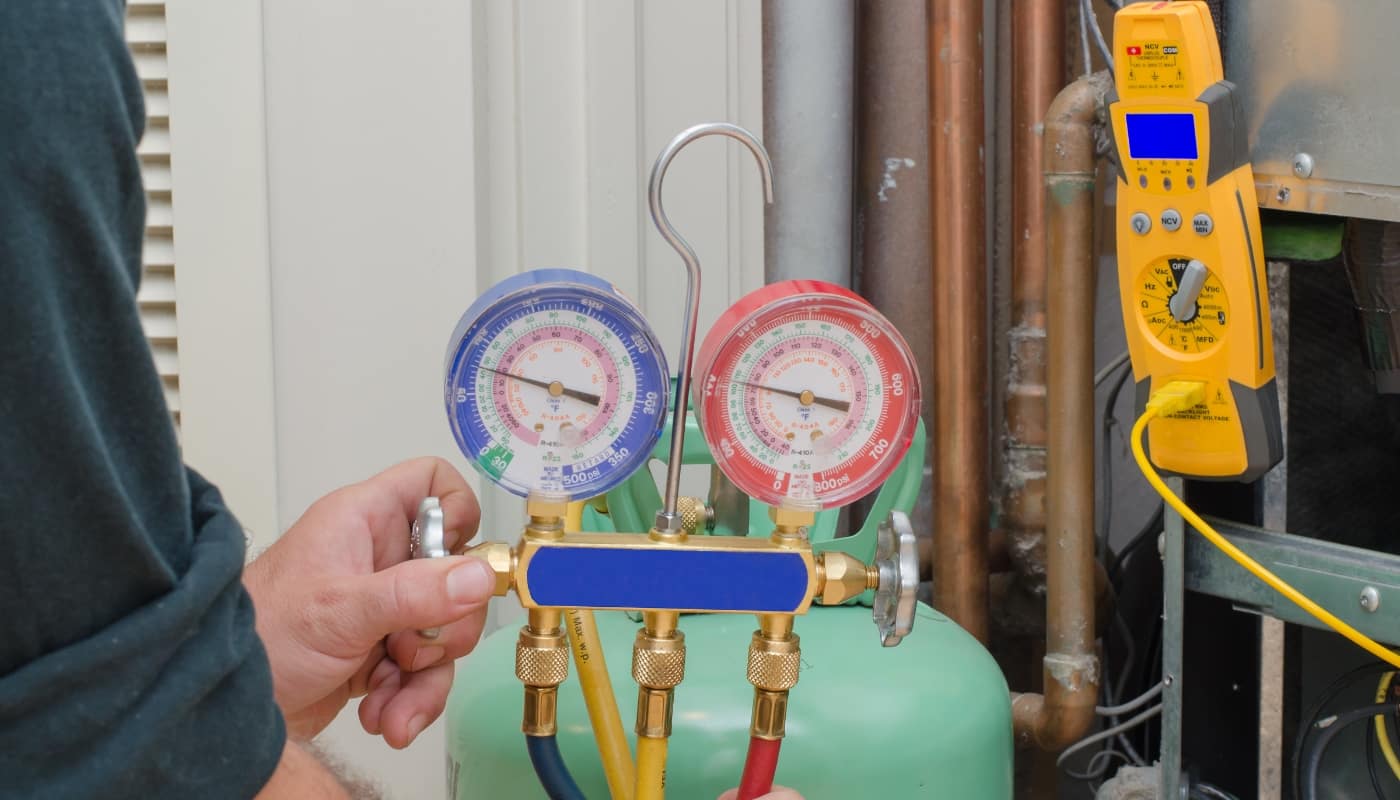
- Pressure and temperature readings. Our technicians pull suction and discharge pressures, check superheat and subcooling, and compare against the manufacturer's target charge for your specific model.
- Leak search if charge is confirmed low. Electronic detection at all the common failure points, plus visual inspection of the line set, coils, and Schrader valves.
- Repair, evacuation, and weighed-in recharge. No guessing. The system is brought back to spec exactly.
This is the Heat Pump Repair process we follow on every call, and it's why our diagnoses hold up.
The Best Defense: Annual Maintenance
The vast majority of refrigerant leaks we find aren't catastrophic — they're slow, and they show up at maintenance long before they show up as a comfort problem. A heat pump maintenance visit includes pressure checks, coil inspection, and connection tightening that catch these issues when they're still cheap to fix.
If your system hasn't been serviced in the last 12 months and you're seeing any of the seven signs above, get on the schedule before the next temperature extreme. Our Comfort Club maintenance program covers two visits per year (one for cooling season, one for heating season) and includes priority scheduling when you do need a repair.
When to Call Comfort Central
Call us at 828-483-4040 if you're seeing any of the following:
- Lukewarm air from the vents in heating or cooling mode
- Ice or frost on the indoor coil or outdoor refrigerant lines
- A heat pump that runs constantly without satisfying the thermostat
- Hissing, bubbling, or gurgling sounds near either unit
- Unexplained jumps in your electric bill
- A breaker that keeps tripping on the outdoor unit
We've been serving homeowners in Asheville, Hendersonville, Brevard, Mills River, and Pisgah Forest for years, and our NATE-certified technicians know how to diagnose refrigerant issues correctly the first time — not just top it off and hope for the best.
Schedule your heat pump diagnostic online or call 828-483-4040 to speak with our team today.